This work is supported by the generous backers who adore my cat stories at Patreon.com/amberunmasked and they also get first access to what’s happening with my books and projects.
Where We Left Off:
In our previous case, the Winchester-Nabu Detective Agency observed a large bird species common to the area but usually hidden in the woods.
This case file contains the investigation into a bird death.
The Mummy:
My shoulders always tense when I get questioned by the Grumpy Old Man. When my text notification pinged one April afternoon, it was no different.
“Did you put a dead bird in the cellar?”
My subconscious was thinking what the hell? while my frontal lobe replied, “Wasn’t me.” I headed all the way down to the main part of the cellar.
He walked forward to an old wooden shelving unit that holds paint cans of various sizes. Right between medium size cans and on top of a small container, there was a mass of variegated brown and white coloring. I honestly would have thought it was a dirty rag. In fact, I probably did on multiple occasions and walked through that room to another without paying attention to it.
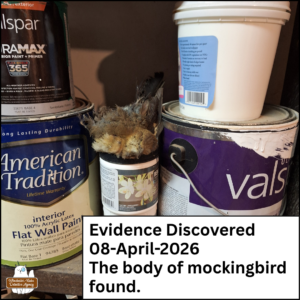


I went to pick it up without gloves on and got reprimanded. The Old Man took a pair of pliers and made me use those to hold the body up for photos and a cursory examination.
“Gus didn’t do this,” I said. “He would have brought it to me.”
The eyes were missing from the orbital sockets. That was the first detail I noticed. There weren’t any active bugs, but there was evidence of ones that had feasted and also died. The body was completely stiff. I looked at the color pattern, particularly at the tail where streaks of white stood out as something important to use for identification. I studied the beak shape and length.
“It looks like a sparrow that grew extra large. The beak is all wrong. It’s definitely too big, but I can’t place the coloring yet.”
“Throw it in here.” The Grumpy Old Man pointed to a black garbage bag on the floor. He obviously knew I was going to keep the body for a post-mortem and possibly crafts. I didn’t want to give it up that easily. I plucked out two of the tail feathers without him noticing and begrudgingly put the corpse into the trash. He immediately emptied the shop vac contents on top of it.
Identification of the Body:
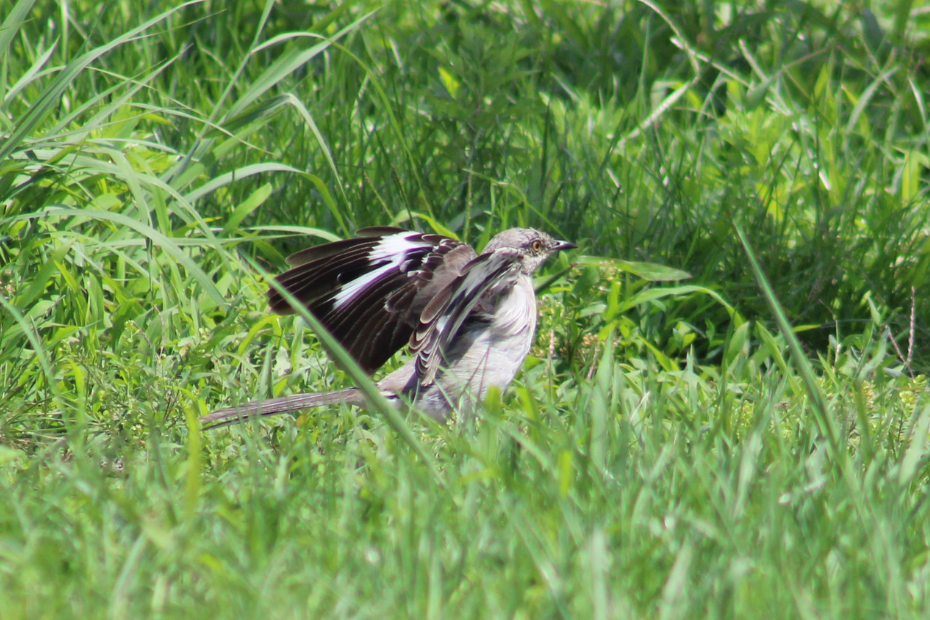
Something in my memory told me that the shape of beak might be a mockingbird. The coloring didn’t look like what I remembered from the two or three mockingbirds I’ve ever seen in person (usually at a distance). If my guess was correct, that would mean for our species identification was specifically a Northern Mockingbird, Mimus polyglottos.

MerlinID app could not come up with any possible matches for a corpse in this condition. I can use it on a bird that’s more fresh and intact. That meant trying iNaturalist which happens to be a place where people can ID both living or dead things (even bones, scat, tracks, claw marks, and nests/constructions). Since iNaturalist is a community where people can narrow down or suggest other species of plants and animals, I decided to upload these photos with the identification of “birds/aves” and let someone else take a shot. My gut was still telling me it was a mockingbird.
It was time to round up the other feather experts in the house: Ollie and Gus. I can’t let Oliver examine any wild feather too long or he chews it. He doesn’t do that with toys. They probably don’t have any birdy aroma anymore after going through cleaning and factory dying.
Gus gave the feathers only a second of his time. “I can’t believe you didn’t sneak the whole bird to us.”
“What could I do? I thought about retrieving it, but he knows me too well. He immediately took the trash bag out to the bin.”

One of the reasons I’m more confident in feather identification when I do collect them is because I found a robust global website that works differently than the US Feather Atlas. It’s featherbase.info and has collections that are mounted the way museums archive. The photos are interactive allowing any feather on the screen to be measured by clicking one spot then another, meaning you can do length and width or length from a specific point. The issue with featherbase.info is that you need to already know the species you want to search. That’s where I compare woodpecker tail feathers to mourning dove tail feathers. It’s helped me immensely with blue jay and mourning dove feathers.

The US Feather Atlas is remarkable in its own way. The limitation is that you can only search wing and tail feathers. I do use it a lot as my first attempt at identifying feathers. Because of this case file, I learned that the Feather Atlas was created by a scientist by the freaking amazing name of Dr. Pepper Trail!
It didn’t take long before the community input from iNaturalist members confirmed that this corpse was a Northern Mockingbird despite the condition of the body.
Oliver directed me on laying out the photos so he and Gus could take it all in. Ollie found it best to have the photos on the floor and lay on top of them. After an interlude of Gus trying to coax Ollie into wrestling, we were finally able to resume studying the case.
“Treats,” Ollie demanded. I got the stash of chicken treats (bird treats feels gross to feed them while working on a dead bird case). Oliver easily knocked over his cardboard tubes to find the snacks. We barely had any information and needed to buckle down.
The Condition of the Corpse:
When I was in the cellar, I talked to myself saying the bird’s condition resembled a mummy. It was dehydrated (obvious from the eye sockets) and stiff. Yet, it hadn’t exactly decomposed. There was substance to the body plus the feathers, beak, and feet. Gus and I recently found a mouse in the same condition in an entirely different building.
We know that in Egypt, mummification requires a ritual which includes removing organs and packing herbs and sand inside and outside the body before wrapping. Then the soul is ready for the after life. In today’s context, mummification is expanded to be synonymous with desiccation (dehydrating the tissues).
No one had prepared this mockingbird’s body in a ritualistic Egyptian style (that would’ve been cool). It was clearly not the second most discussed mummification—a bog body. Nor the third most discussed—frozen. No, this bird was some other kind of mummy. More like nature’s taxidermy service.

Why we’re classifying this natural mummification:
According to a fancy scientific paper I found, dehydrated bodies are part of the “mummy” family.
“The transformation of a once living body or tissue into a state of arrested decay by moisture loss and tissue desiccation is often called mummification and refers to all natural and artificial processes that cause desiccation of (soft) tissue of the body [5]. It is important to recognise that descriptive terminology is often used fairly loosely in both post-mortem reports and archaeological assessments and that the underlying processes themselves reflect more complex changes. The word ‘mummification’ is derived from the Persian word múmiya (mûm in Arab), meaning bitumen. Technically it could be argued that the term should be reserved for cases of artificial preservation of soft tissue. Yet, today mummification can be interpreted by its broader association with tissue desiccation, or the common usage of the word to imply survival of soft tissue by any mechanism [6].” —Eline M.J. Schotsmans, et al.
“You should find an expert on bird deaths,” Ollie said.
I looked from one cat to the other. “I thought that was you guys.”
“This is a unique case,” Gus said. “We’ve never had a bird corpse like this before. They’re usually…fresh.”
“Before we go any further,” Ollie said, “we have to make a pact that no one will tell The Cook about this. Swear to it! The women on her side,” Ollie looked at me in acknowledgement, “have always been superstitious. A dead bird inside or near the house can be seen as a bad omen. She gets extremely upset when dead birds are found outside our doors.”
I absolutely agreed. Gus and I promised Oliver that we wouldn’t mention it to his favorite human.
Help with the Investigation:
Since I discovered Dr. Pepper Trail had retired, I searched for other forensic ornithologists. I hit the jackpot with another magnificent name for a nature scientist. The Smithsonian’s Feather Identification Lab Program Manager is named…Dr. Carla Dove! I decided to email her just as I had a scientist about bobcats explaining that I was writing up a case for cat detectives. I included the photos with my message. Here’s part of her reply:
“I agree with you that this is a Northern Mockingbird, but it looks so rusty in color in some of the photos. Mockingbirds are usually gray and males and females are similar in plumage. It appears to be an adult because there is no streaking on the breast.
Sometimes prepared (i.e. taxidermy) birds ‘fox’ in color to a rustier appearance. Foxing is a natural discoloration that can occur if the bird specimen is exposed to light or heat for a period of time. It rarely happens in museum research collections because we keep the bird specimens in dark cases and in somewhat controlled environments. However, some of the older bird mounts that were on exhibit here for a long time (before the age of archival light and glass) have experienced ‘foxing’. So, if the color in some of the photos is real (rusty), that could be an indication that the bird was exposed to heat or light for a long period of time (don’t know how long). It is also desiccated as you say, and mummification takes a while too and also in very dry conditions.
But one thing is for sure, it was not freshly dead. Other thoughts could be that it got inside somehow, and the cats did the ‘play’ thing and had a good ole time before it managed to escape to the paint shelf and die. I don’t know how long you have had the cats, but that is also possible. Last winter, we had a small bird get into my mom’s basement and it must have exhausted itself tying to escape through the closed small window and finally either hit its head too many times or died of exhaustion. We found it dead by the casement window and I do recall it being rather dry. So, maybe if it is indoors for a bit after dying it will desiccate like that.”
Dr. Dove’s answers explained a lot about this unfortunate bird situation. Even if Gus or Ollie had been playing with the mockingbird, it likely died of exhaustion. It dried out from the trouble with our furnace which was blasting too much heat for the whole winter.

“Guster, we need to talk.” I called him a few times to get him back to the office after a brief bout of the zoomies.
He sat next to me and began cleaning his black fur. Oliver moved to one of his favorite spots under a chair next to his office.
“Gus, did you fight with that bird?”
“I tried, but it stayed out of my reach. That feels like ages ago,” he said.
Other than a couple of photos, we didn’t have any data on mockingbirds from our neighborhood. The best photos I’ve taken were of one I watched in Mercer County Park which is far from here. I went back to iNaturalist and filtered for the species within New Jersey between September 1, 2025 to March 31, 2026. There were more than I expected. Most were in the shore area, but there were enough up in the Morris County area to prove that they were present even during the harsh snowy winter.

Case Findings:
The Winchester-Nabu Detective Agency opened one of our most peculiar cases to date. A mummified mockingbird was found in the main part of the cellar. It died among paint cans on a shelf close to the hot furnace and hot water heater. We aren’t sure what date it came into the house, but there were weeks where men were trying to drill holes through the rocks to run pipes to the outside. The bird didn’t decompose as it would have in a different kind of environment. It never smelled or rotted. It dessicated right there between the paint cans where it landed in an attempt to recover from the exhaustion of looking for a way out. This mockingbird had been dead on those paint cans for months.
Burton Guster Nabu admitted that he did find a bird and tried to catch it, but he didn’t remember details about the bird’s identity. As soon as it was out of his reach, he gave up and moved on.
The Grumpy Old Man discovered the corpse in April 2026. Photos were taken, but the body was immediately thrown out with the garbage. Two tail feathers were kept for our evidence archives.
We got help from an expert at the Smithsonian Institute’s Feather Identification Lab. Dr. Carla Dove basically solved the case for us! She had reasons for the mockingbird’s mummified state and its discoloration. Her input helped us come up with the window of death being from late fall 2025 to late winter 2026.
Unfortunately, unless a witness comes forward for information about this victim, we don’t know much about their life. What about a name? Who was this bird? What was it like when it was alive? Those intimate details about the mockingbird will probably remain unknown.
We did not have time to perform a ritual to keep the mummy bird from rising.
Case Status: Closed

Other Facts About Mockingbirds:
These songbirds have a subtle physical beauty with round midsections and long elegant silhouettes because of their tails. However, they are known to be fierce fighters which is probably not something a human thinks about when observing them. These birds are extremely territorial. They generally weigh 1.6-2.0 oz (45-58 g).
Mockingbird males construct their family nests. This most often is between 3-10 feet off the ground but as high as 60 feet from the ground. This trivia makes it even more mysterious as to why a mockingbird would have found its way to the lowest part of the house.
Because humans can’t help clinging to things and controlling them, mockingbirds in the wild nearly disappeared from the East Coast during the 1800’s. People took them from nests or trapped them to be caged as pets, fetching a price of up to $50 back in 1828. These talented birds are known for learning around 200 songs which the males, in particular, sing day or night from February through August. It’s been noted that they will sing even more during Full Moons.
Resources:
https://www.allaboutbirds.org/guide/Northern_Mockingbird/overview
Eline M.J. Schotsmans, Wim Van de Voorde, Joan De Winne, Andrew S. Wilson,
The impact of shallow burial on differential decomposition to the body: A temperate case study, Forensic Science International,
Volume 206, Issues 1–3, 2011, Pages e43-e48, ISSN 0379-0738, https://doi.org/10.1016/j.forsciint.2010.07.036.
(https://www.sciencedirect.com/science/article/pii/S0379073810003865)
Abstract: Extant literature contains a number of specific case studies on differential decomposition involving adipocere formation or desiccation, but few describe the co-occurrence of these features within a temperate climate. The case of a 65-year-old male, partially buried in a shallow grave for 7 months, is presented in which the soft tissues of the body were outwardly well preserved. The right leg was desiccated, some parts of the body were covered with adipocere (head, neck, right shoulder, upper torso and left leg) and other parts could be classified as in the early stages of decomposition. In this study the taphonomic variables resulting in differential decomposition with desiccation and adipocere formation are discussed.
Keywords: Differential decomposition; Desiccation; Mummification; Adipocere; Taphonomy; Clandestine burial
